ISSUE 83
CONTENTS
FEBRUARY 2022
Sandra Crouch
Ann Hudson
Carolyn Oliver
Patrick Redmond
Satoshi Iwai
ART: Kaleigh Dandeneau
Miriam Kramer
Cate McGowan
Fia Montero
Alison Rosenberg
Michael Steffen
CONTRIBUTORS

IMAGE DESCRIPTION: This collage has a background of black bricks. The middle portion is scribbled over in white as if this part of the background has been erased. Blocked letters that could have been cut from several magazines (or drawn on paper) spell out "INVISIBL" and "VILL" "AIN." The image's upper portion shows a drawn, black horizontal DNA coil and several red arrows that all point toward the coil. A gray pair of scissors seems ready to snip one of the coil's edges. The bottom of the image shows a picture of a skeleton's pelvis surrounded by drawn blue lines like lightening. A scribbled black line in marker cuts through the white part of image and extends downward to merge with the skeleton's spine.
Sandra Crouch
OPEN THIS WHEN YOU NEED ME MOST
I'm tired of talking about breasts.
My shoulders drop into the bed of my body.
If I lift the sheet
I will reveal the heart huge
as a stillbirth.
I can't decide if it is a gain
or loss—to feel my heart
just on the other side of my skin,
so close
that I could reach in
and pluck it,
like a pear.
Healing is never what you think, she says.
I know she is telling me
that it is time
to say goodbye
to the mother in me,
the eternal caretaker;
that my ovaries
are no longer the pearls
strung for other people's necks.
How a horse will run until it breaks
into weather—into wind.
Here the sky thins
and spirits spill
through the floor of heaven
into the world.
Tell me it was for the hunger
and nothing less.
Braided Cento:
Mark Cunningham, Body Language, Tarpaulin Sky Press, 2008
Ginny Jordan, Clear Cut, Lantern Books, 2012
Ocean Vuong, Night Sky With Exit Wounds, Copper Canyon Press, 2016
Title is a line by Ocean Vuong.
Ann Hudson
HIPPOCAMPUS
My predatory curiosity needles the dark.
I click on the lamp. I hunt for pictures
of the human brain, its folds and trajectories.
Look: long-term memory and spatial relationships
in a part of the brain named for the seahorse,
which it was thought to resemble.
And here’s the amygdala, named
for an almond, that triggers fear. I twist
in the sheets and think about all the ways
my children might suffer. They are heavily asleep,
their limbs pale and askew as if
their bodies had been dropped there
from a height I’m too afraid to name.
Carolyn Oliver
THE STRANGER
says to me / at the wake / Oh, all those / Christmases, / those birthdays / dear, just think! / I cannot / stop thinking /she forgot / to mention / the wedding / we won’t have / the dress I / wish you’d tear / like rags from / my body / left behind / I’ve become / pine needles / dry scattered / underfoot / (a real mess) / soot needing / to be licked / from singed skin / rough fingers /
yours \
Patrick Redmond
WERE YOU SHOWING ME SOMETHING
As you turned away from the black mold in the air
holding taffeta against your body
like ancients held up fish in hues of burned bone?
I have only seen out these north & south windows
all spring.
I have only felt the drink in my palms
& the waves through the self-inflicted-bruises
in my temples.
I’m concerned with everything domesticated.
In our tongues pressed like gull wings, dusted with cinder.
In the aesthetics of a mantle desiring fire.
In the slapping of clapboard torn from the wall
for the hormonal importance of making sound.
Is there more than the anxiety of this room?
I’ve yet to clean up the teeth that fell out in a dream.
On the screen pigs un-flayed arrange themselves
pleasing adorable slaughter
While I begin to draw my body
without reflection.
I’ve assumed an amorphous jagged form,
warming your spine as it walks the rooms
burning sage. I’m nervous.
I never enter without inhibition. I never enter
without inhibition. You fold a credit approval into a mirror.
In red ink beneath 18% interest
my body resembles bones seeing fruit.
I need to dust the carbon off
the last animal that made it inside.
The fabric sways beneath you, covering the pleasure of knowing
you’d feed me to memory if my skin smelled of soil.
Satoshi Iwai
BLUE SCORPION
When he wakes up from a dream of walking down the long corridor paved with something flabby, he finds the scorpion which has been tattooed on his chest is sliding out of the sweaty skin. The creature crawls on the hallway and heads for the kitchen. Using its curved tail skillfully, the scorpion takes out a carton of beer from the refrigerator and takes it to the living room.
He sits on the couch and watches the TV shopping channel with the scorpion. The scorpion empties the cans one after another. Its blue body gradually turns red. Drinking up the last beer, it begins weeping and orders him to buy the exercise machine appearing on the screen. There must be another life for me! He leaves the scorpion and goes back to bed. The moonlight from the window colors his thin chest blue. He falls asleep and restarts walking down the endless corridor which has grown flabbier.
Kaleigh Dandeneau
DELICATE
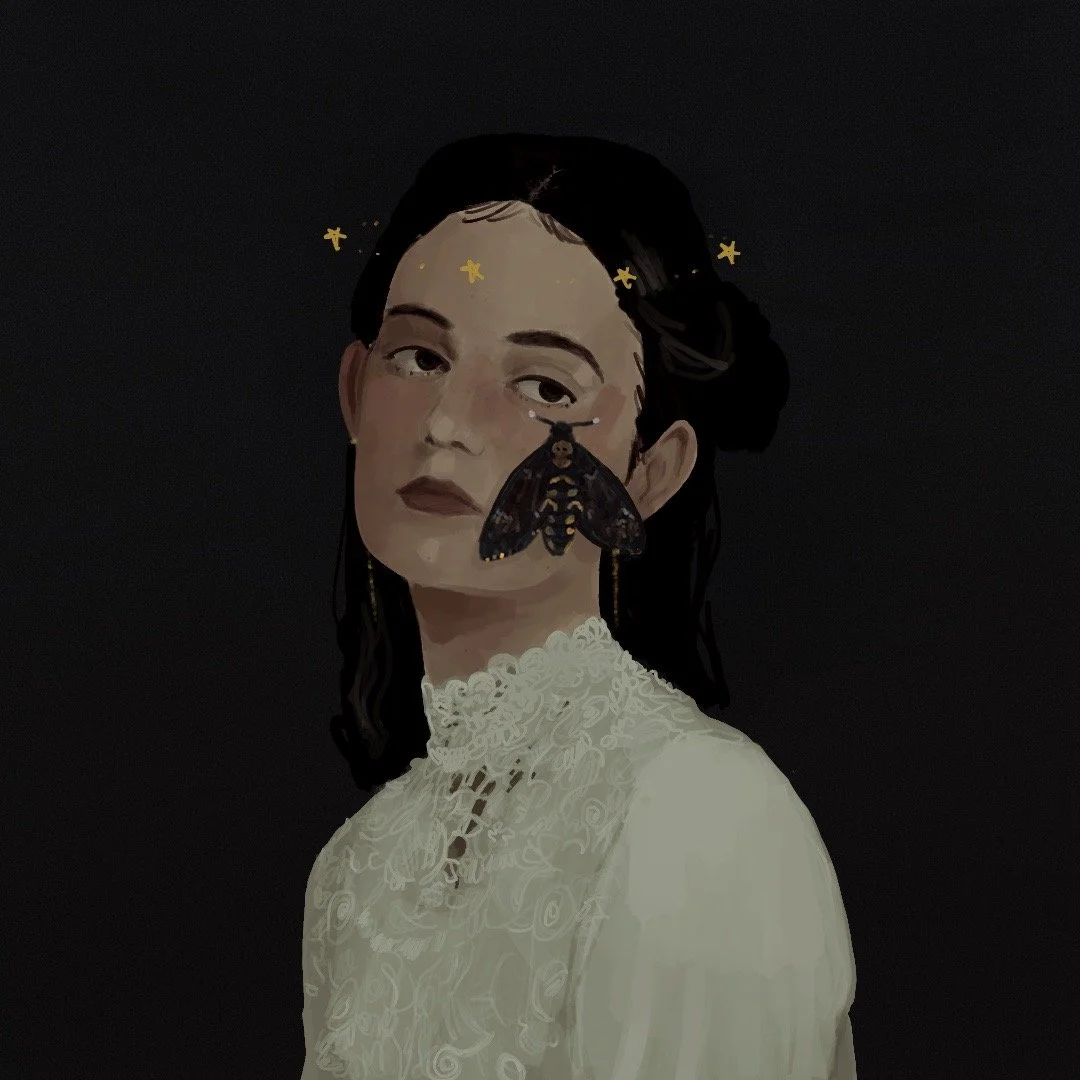
IMAGE DESCRIPTION: This portrail shows a woman in a white lacy blouse with a high collar. There is a large black moth on her cheek, her hair and forehead are encircled by stars, and her dark brown hair merges with the black background. She has tan skin, dark brown eyes, and an impassive expression.
SELF PORTRAIT—BUST
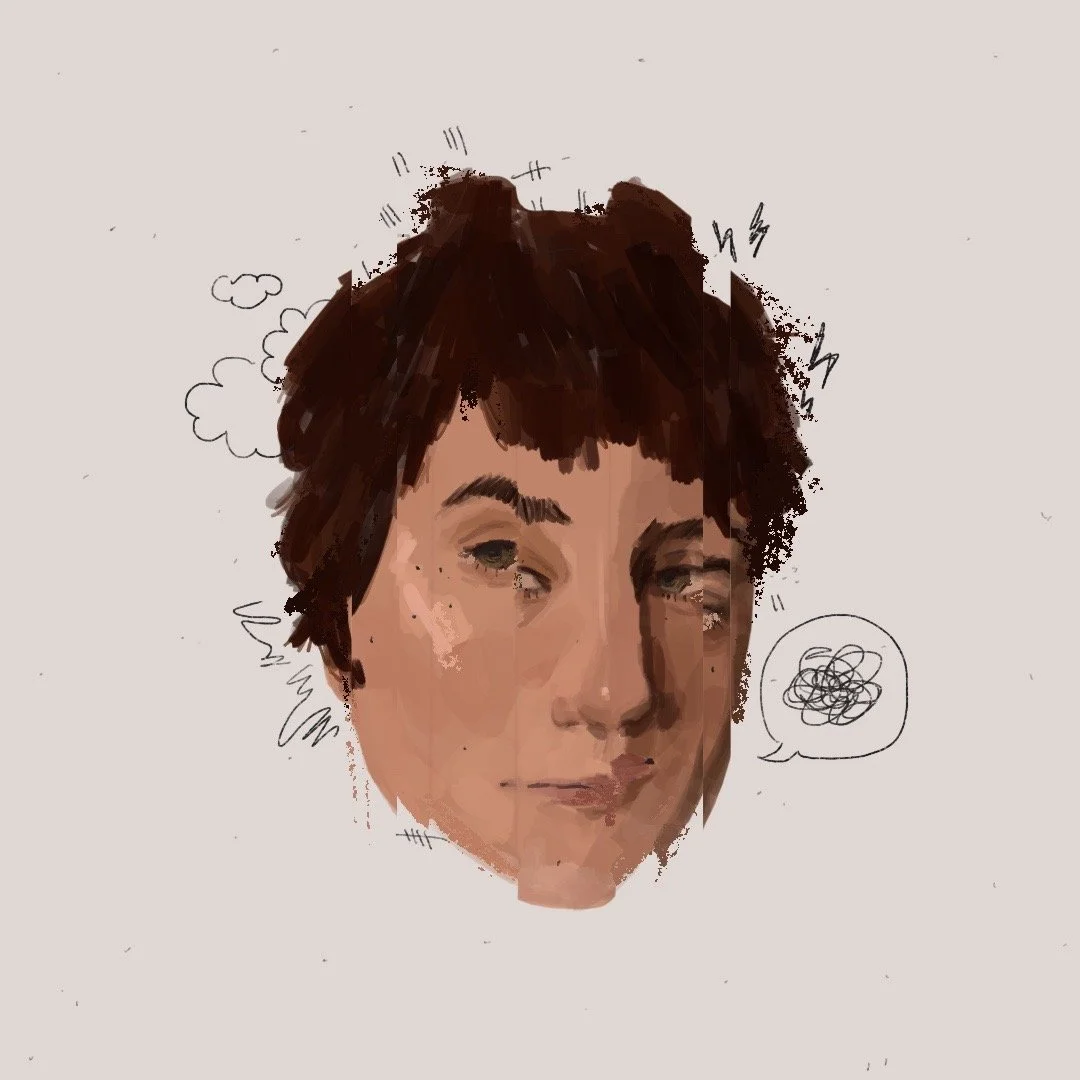
IMAGE DESCRIPTION: A painted woman's face with hazel eyes and short dark brown hair has been dividied into vertical strips. Some strips have been pulled slightly downwards so that the face is distorted. The background is pale gray with pencil scribblings around the face. The scribblings resemble clouds, tally marks, and a speech bubble which holds another dark scribble.
CARE
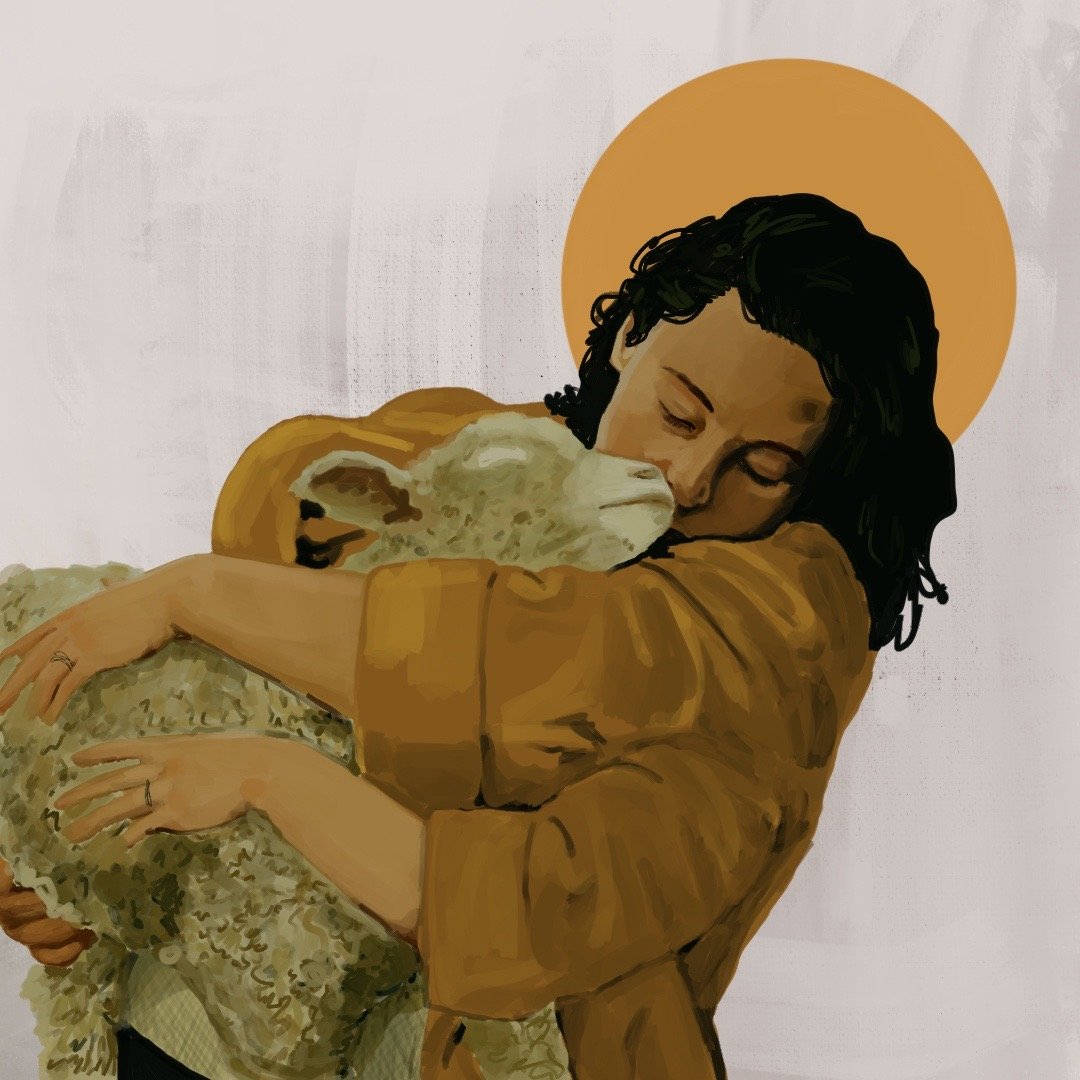
IMAGE DESCRIPTION: A woman with dark hair, mustard-colored robes, and a saint-like halo holds a white lamb and kisses its muzzle. She has two sets of arms. She may be the woman in the first picture. The lamb's eyes are closed. The background is the same pale gray as in the second picture.
Artist statement:
As an artist living with multiple chronic illnesses, it's important for me to document the journey that goes on both within and without my body. The years of learning, growth, and witnessing a complete metamorphosis of the self has given me a unique and odd view of the world around me. It's important to me to represent these feelings, lessons, and setbacks through as many works of art as possible. My work follows my body through denial, lost futures, and a curious excitement to the new world tomorrow brings.
Miriam Kramer
KOMODO DRAGONS EAT ANIMALS THE SIZE OF WATER BUFFALO
If I could choose my next body after rebirth,
I would be a lizard. This may not be the most linear
path, but healing often isn’t.
Certain lizards, geckos for instance, do not have eyelids.
I tell myself I saw it coming and ignored the danger.
Chameleons communicate through color,
I would be a bright embodiment of threat.
I would come back vibrant, glittering
with warning of my venomous tongue.
I would not remember being the woman
who didn’t fight back, who whispered
her refusal from a throat hindered by rising bile,
as if clutched by a predator’s grasp.
I would not remember the peripheral
sightline of green beer bottles.
For weeks after, I couldn’t call
it rape. I camouflaged myself in softer
language, fastened to self-blame,
spending nights praying to not wake up.
If I came back as a lizard,
I would protect my soft and scaled
belly through autotomy,
I would know my potential to self-amputate,
sacrifice an appendage for preservation,
and my ability to regrow.
I would be fluent in regeneration,
A self-defense outside of fight or flight response.
In trauma therapy, I learned
there is also freeze, submit, and attach.
I would not remember days spent
in bed, clutching my knees to my chest. My own nails
like claws in my shoulders just to feel
connected to myself. If I came back a lizard,
I would not mourn my molted tail
the way I’ve mourned my dignity.
I tell myself if I could have shed a limb
to escape, I would have.
I would come back a lizard, tail-less, but still
intact. True, my regrown tail would lack vertebrae,
but that’s no worse than feeling spineless.
On my bad days, I still call myself
coward instead of survivor.
Cate McGowan
PSYCHO
“[W]here I find myself surprised—and not so pleasantly surprised, more often than not,
surprise instead into a heightened awareness of something troubling.”
—Carl Phillips
The blonde actress plays herself as a redhead. Maybe
like in biopics I’ve watched too many times. I know
all the lines. Too unself-conscious for clichés, settings
unsettle stories. That memory remains something picked
at. The balled-up floss of reminiscence. What’s left
of an Upstate winter so long ago. Yes, that memory.
Bathtub scum slick between my toes. Between my legs.
The plop of single drops from the faucet, acoustic effects
like film cues. Something troubling, something tragic
will materialize in the next frame. Mold flowers on the sink
and shelves. The papered ceiling’s blossoms crane to catch
nakedness, and I slide inside the suds, inside the deep
basin. You swipe the fogged window with your sleeve.
The squeak’s a harbinger.
Fia Montero
HER MORNING
is a science lesson
beginning at the scale
with a quick
mass check, a sigh
as she carefully binds
rambling anatomy,
smoothes lace and wire
over gravid breasts,
is a culinary lesson
wraps strawberry
plump hips, edible
thighs and belly
with tights that itch
but are aces
at sucking in that last
half-inch.
is an art lesson
she paints the depth
of a woman
in layers across her
aging face,
a trace of fecundity in
the pink stain
dabbed on thinning
lips, rubbed
into once-rounded
apple cheeks,
the child watches.
a daughter peeks
around the corner,
soaking in
the metamorphosis
of the exceptional
to the mundane.
Alison Rosenberg
CRYING AT THE MET IS MY LOVE LANGUAGE
It never felt quite right. Sitting criss-crossed
on a silly carpet, I learned that you can have
two different emotions at once, and that
doesn’t make either one of them less true.
I recall this when he tells me that I made him
cry today, for the first time in a decade. I like
to think that he’s referring to the same
type of tears I shed when I spend too
much time in the Ancient section,
falling in love with all the people
who wore emerald necklaces and
treasured their little sculptures of animals
so ardently that the trinkets are still
perfectly preserved, some five thousand
years later. But that doesn’t sound right,
does it? On that polka-dotted carpet I also
learned that it’s important to make people
happy − so now I try to find ways to make
my anxiety-induced indigestion seem sexy.
I can’t help myself. The tattoo on my ribs,
there just to revel in the fact that no one
can take it away from me, will be gone
with my skin eight to twelve years after
I die. The flimsy plastic that encases
a roll of toilet paper is lucky: it will last
up to a thousand before it disappears
on its own accord. Styrofoam never
has to biodegrade. When a new
generation, dewy and curious, builds
their own museums, I hope they find
the plastic banalities that we threw at
each other in fits of laughter. If I’m
lucky, they’ll recognize those scraps of life for the
obliterated moments I wanted them to represent.
Michael Steffen
THE OLDER I GET
The elderly woman I watched tending
a far-off grave in the cemetery
turned out to be a white hydrangea
genuflecting in a cold breeze.
Are those butterflies blinking on and off
in the window’s vivid sky,
or is it a blue field of kites
and their papery-quick evasions,
jittery as the comings and goings of my body—
departure of sight, arrival of doubt,
my addled brain’s mixed messaging—
my body becoming winter and ice,
turning toothless, drooling in my farina,
rarely straying from home
and yelling at things that can’t yell back—
the suddenly mute blower, garbled leaves
swirling in the driveway—
my raspy voice grumping around the yard.
I spy with my cloudy eyes
a floral nightdress drying on the line
or a trellis of roses? The world is becoming
my best guess—a red thread on my white shirt
or a thin ribbon of blood?
Either way, it’s a tightening strand.
Issue 83 Contributors
Sandra Crouch is a poet, artist and letterpress printer living in Los Angeles, California. She has studied poetry on two coasts and two continents for more decades than she may admit—most recently with Hollowdeck Press. Sandra's poems are forthcoming in Unlost. Follow her on Twitter @iamsandracrouch.
Kaleigh Dandeneau is a visual artist from Tennessee, living with and advocating for chronic and invisible illnesses. She uses her art to document this journey through the flesh, the mind, and the ever changing world around her. You can contact Kaleigh and follow her body of work at instagram.com/kmaeby. She continues to create in sickness, in health, and in love.
Ann Hudson’s first book, The Armillary Sphere, was published by Ohio University Press; a chapbook about radium, Glow, is available from Next Page Press. Her poems have appeared in Cider Press Review, Orion, Crab Orchard Review, Colorado Review, North American Review, Spoon River Poetry Review, and elsewhere. She is a senior editor for RHINO, and teaches at a Montessori school in Evanston, Illinois.
Satoshi Iwai was born and lives in Kanagawa, Japan. He writes poems in English and in Japanese. His English work has appeared in Heavy Feather Review, FLAPPERHOUSE, Small Po[r]tions, Your Impossible Voice, Poetry Is Dead, and elsewhere.
Miriam Kramer resides in New Jersey and works at an educational nonprofit. Her work has appeared in Anti-Heroin Chic, Rising Phoenix Review, and Rat's Ass Review. Her debut chapbook, In Time This Too Shall Be Proven Foolish, was published by dancing girl press. Miriam has read poems out loud to friends and strangers in many parking lots and established venues all over the United States.
Cate McGowan is the author of the novel, These Lowly Objects. Her short story collection, True Places Never Are, won the Moon City Short Fiction Award and was a finalist for The Lascaux Book Prize. In addition, McGowan’s poems, stories, and essays have appeared in many literary outlets.
Fia Montero is an autistic writer based in Des Moines, Iowa. She holds a BFA in art and design from Iowa State University, and a BSHS in pre-medical studies from Mercy College of Health Sciences. Her poetry has been published, or is forthcoming, in West Trestle Review, Literary Mama, and Passengers Journal. Reach her at fmonw@gmail.com.
Carolyn Oliver is the author of Inside the Storm I Want to Touch the Tremble (University of Utah Press, 2022), winner of the Agha Shahid Ali Prize. Carolyn’s poems appear in The Massachusetts Review, Indiana Review, Cincinnati Review, Radar, Shenandoah, 32 Poems, Southern Indiana Review, Cherry Tree, Plume, DIALOGIST, and elsewhere. Her awards include the E. E. Cummings Prize from the NEPC, the Goldstein Prize from Michigan Quarterly Review, and the Writer’s Block Prize. (carolynoliver.net.)
Patrick Redmond is a writer, teacher, and musician living in Brooklyn, NY. Recent writing is forthcoming or featured in Matter Monthly, -algia, The Columbia Review, The Hunger Journal, and elsewhere.
Alison Rosenberg is a writer and event planner living in Brooklyn. She graduated college in 2020 with honors in poetry, and is now eagerly delving to the literary world of New York City. Her work has previously appeared in The Orchards Poetry Journal.
Michael Steffen’s fourth poetry collection, Blood Narrative, was recently published by Main Street Rag Press. New work has appeared in Chiron Review, The Chestnut Review and The Comstock Review. Michael is a graduate of the MFA writing program at Vermont College and currently lives in Buffalo, NY.